
Franklin VINELink Coverage
Idaho VINE is sponsored through the Idaho Sheriffs’ Association. Participating Idaho jail booking interfaces and IDOC supply status changes. It can serve a Franklin arrest housed in an Idaho jail and an IDOC client. It does not create a Franklin roster, cover Cache County’s Utah jail, or replace BOP and ICE locators.
Idaho VINE also has a court-notification layer developed with the Idaho Supreme Court. Court and custody notices remain distinct. A bond event may explain legal authority, while the host jail records physical departure.
Search Franklin VINELink Records
Open the Idaho VINELink portal and match one person carefully. A name alone is unsafe.
- Choose Idaho and the custody or offender search.
- Enter the legal name or identifier.
- Use facility and age filters when offered.
- Compare agency, age or birth data, and offender ID.
- Open the match and note status, date, location, and agency.
- If absent, retry an alias and contact the likely host.
The official interface is shown below.
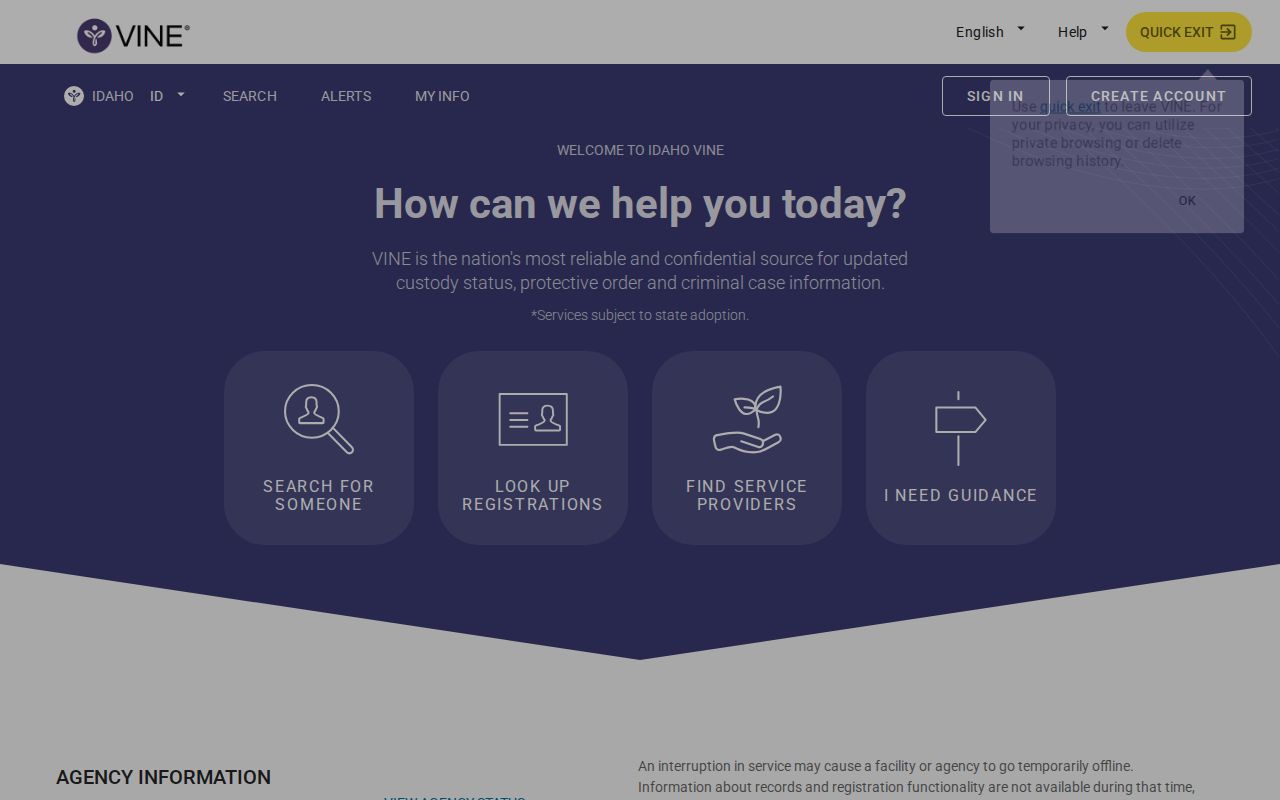
The statewide entry point must be narrowed to the right person and agency.
Franklin VINELink Release Fields
Record the agency’s label as shown rather than converting each event into “free.”
| Field | Use |
|---|---|
| Name and identifier | Matches the person |
| Agency or facility | Identifies the source |
| Custody status | Shows the supplied label |
| Status-event date | Dates the update |
| Notification choices | Lists available alerts |
A released result leads to the host jail’s release type and destination. Then check iCourt or IDOC. Transfer can create a release event from one facility while custody continues elsewhere.
Register Franklin Release Notifications
Registration starts from the correct in-custody record.
- Select Register or the notification option.
- Choose phone, text, or email.
- Enter and confirm the contact point.
- Select the offered status events.
- Create a four-digit phone PIN.
- Save and confirm registration.
IDOC says calls repeat every two hours for up to 48 hours until the PIN acknowledges receipt. Idaho VINE’s number is 1-866-984-6343.
The IDOC Victim Services page documents the restored service.
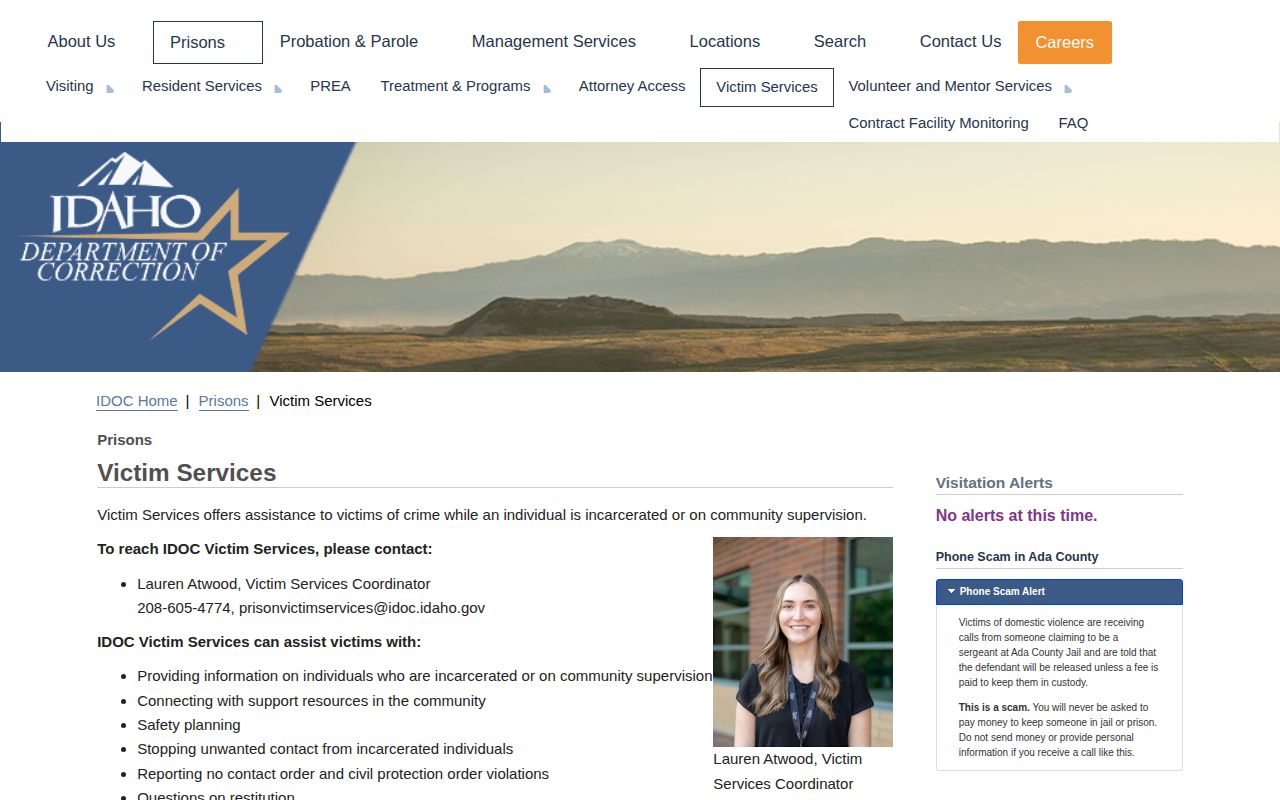
This later source controls over stale outage text on an older Commission page.
Confirm Franklin VINELink Alerts
Write down the wording, time, agency, and ID. Ask the releasing jail for type and destination. Search iCourt for the order. Check IDOC when state custody or supervision is possible.
No result can reflect spelling, alias, a nonparticipating or out-of-state host, lag, or another system. BOP covers federal records, and ICE has its own locator. The Franklin released-inmate records path separates those channels.
Idaho VINE is especially useful because Franklin lacks one county feed. Service options can change, so check the live portal when registering.
Note: Do not treat a notification timestamp as the host jail’s exact physical exit time without confirmation.
Franklin VINE Status Reconciliation
A useful alert review follows the custody chain. If Caribou reports release, ask whether the destination was Franklin court, another jail, IDOC, or the community. If the person moved to Bannock, a later Bannock event may supersede the first notice. Cache County lies outside the Idaho VINE layer, so its official Utah jail record must be checked separately.
IDOC uses its own status terms. “In custody” is clear state custody. “In community” is the strongest quick sign of placement outside an IDOC prison, but the detail must identify probation or parole. “Active Bench Warrant” proves neither custody nor release. “Discharged [date]” means the shown sentence was satisfied. Compare those fields with the VINE agency and event date.
When sources conflict, do not choose the newest timestamp blindly. Ask each custodian what its field means and which destination it recorded. A jail can post departure before IDOC posts reception, and VINE can notify after an interface update. The sequence may be accurate across all three records.
Franklin Court Notification Layer
Idaho VINE combines jail and IDOC notification with a court-notification component. That layer helps follow a Franklin legal event, but it does not convert the court docket into a physical custody log. Search iCourt for the bond order, dismissal, judgment, probation order, commitment, warrant, or satisfaction that explains the legal setting.
Public iCourt searches accept a name in “Last, First” order or a case number. Compare the Franklin court location, case year, charge degree, and public birth-year data before matching. A no-result may reflect formatting, CAPTCHA, sealing, or access rules. It is not a reason to substitute a commercial result.
Reconcile Franklin VINE Status
A useful alert review follows the custody chain. If Caribou reports release, ask whether the destination was Franklin court, another jail, IDOC, or the community. If the person moved to Bannock, a later Bannock event may supersede the first notice. Cache County lies outside the Idaho VINE layer, so its Utah jail record must be checked separately.
IDOC uses exact terms. “In custody” is state custody. “In community” is the strongest quick sign of placement outside prison, but the detail must identify probation or parole. “Active Bench Warrant” proves neither custody nor release. “Discharged [date]” means the shown sentence was satisfied. Compare those fields with the VINE agency and event date.
When sources conflict, do not choose the newest time blindly. Ask each custodian what its field means and which destination it recorded. A jail can post departure before IDOC posts reception, while VINE can notify after an interface update. All three records may accurately describe separate stages.
Franklin Court Notification Context
Idaho VINE’s court-notification component helps follow a Franklin legal event, but it does not convert the court docket into a custody log. Search iCourt for bond, dismissal, judgment, probation, commitment, warrant, or satisfaction. Public Smart Search accepts “Last, First” name order or an exact case number. Compare court location, year, charge degree, and public birth-year data before matching.
Case tiles can include party details, bond data, dispositions, a register of actions, and judgments. A bond event may show authority to leave, while a later warrant or commitment changes the path. The clerk supplies official copies. A no-result may reflect formatting, CAPTCHA, sealing, or access rules, so it is not proof of release.
Franklin Federal VINE Boundaries
VINELink is not the BOP Inmate Locator. BOP searches use federal numbers or a name with demographic filters. A past BOP release date can show departure from BOP custody, but another authority or federal supervision may follow. “IN TRANSIT” remains custody.
ICE ODLS uses an A-number and country of birth or exact biographical data. Lag, spelling, transfer, removal, protected status, or brief custody can cause no result. USMS lacks an equivalent public real-time locator for pretrial prisoners. Preserve the host jail’s transfer destination before using these federal channels.
Protect Franklin Alert Accuracy
Save enough information to verify the event without publishing unnecessary personal data. Record the offender or booking number, agency, facility, status words, and event time. A birth year can help distinguish two people, while a full birth date is rarely needed for a public explanation.
Later changes do not always make an earlier notice wrong. A person may be released from one host, received by another, placed on supervision, or made subject to a warrant. Describe what the agency reported as of the notice time and recheck the current record before relying on the result.
For corrections, contact the agency that supplied the field. VINE relays agency data. It cannot rewrite a jail event, court judgment, or IDOC sentence record. Provide the source URL, identifier, disputed wording, and supporting official record when requesting review.