
Franklin Projected Versus Actual Release
A projected or tentative date is an estimate or conditional milestone. Actual release is the physical event recorded by the jail or IDOC. A Franklin pretrial detainee has no sentence-based date unless a court order and conditions create a release path. Bond authorization still does not prove processing ended.
For IDOC, Parole Eligibility Date is the earliest parole-consideration milestone. Next Parole Hearing Date is procedural. A Tentative Parole Date comes from a Commission action and remains conditional. Released to Supervision is a past placement event. Sentence Satisfaction Date marks the end of the represented sentence. None may be silently renamed “projected release.”
Find Franklin Release-Date Milestones
Start with custody class. County, state, federal, and immigration systems do not share one calculator.
- Get the Franklin case number and every judgment or amended judgment.
- Identify fixed and indeterminate terms plus concurrent or consecutive language.
- For IDOC, search the Resident/Client Search and note its data-current date.
- Read PED, hearing, supervision, and satisfaction fields without merging them.
- Check the Commission notice for a TPD or other action.
- For a host-jail sentence, ask the court for the credit order and the jail for its time computation.
The IDOC detail layout is shown below.
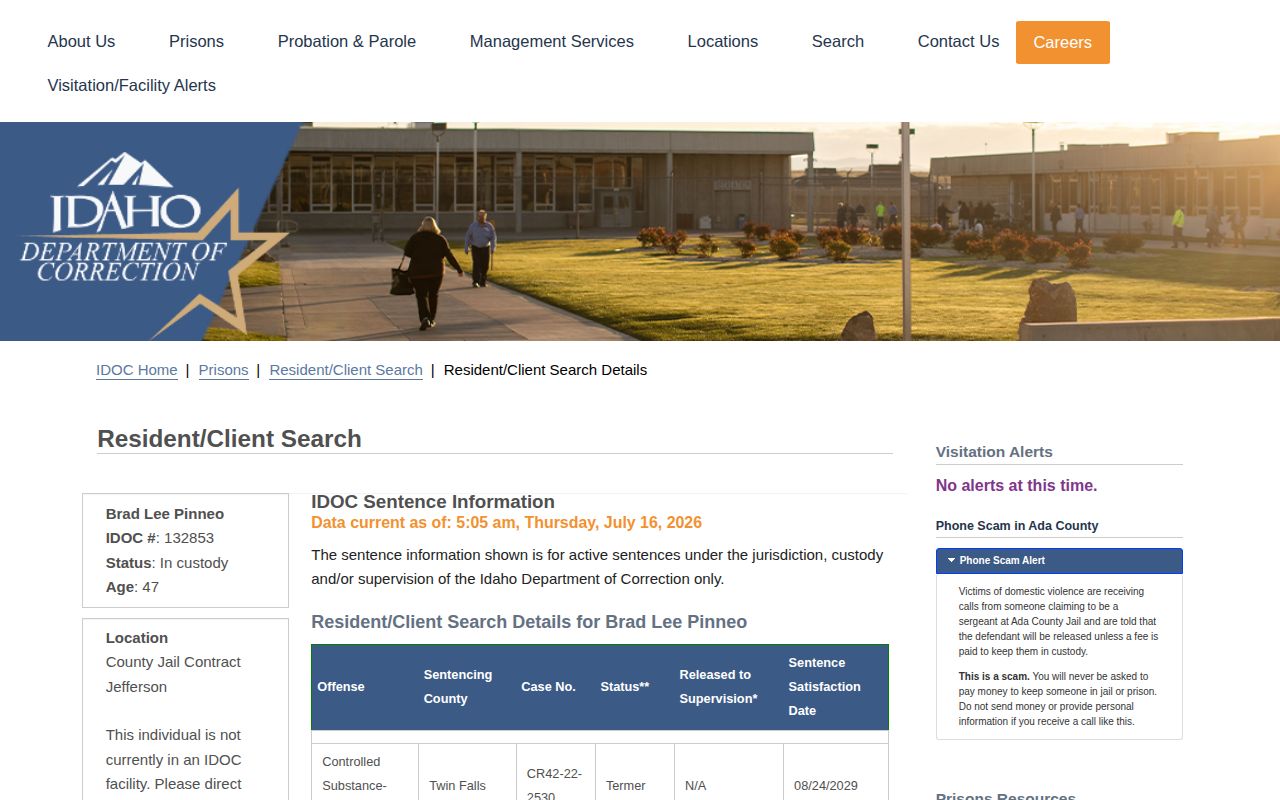
The fields demonstrate why one displayed date cannot answer every release question.
Franklin Release-Date Computation
Idaho Code § 19-2513 uses a unified sentence with a fixed minimum and a later indeterminate portion. § 20-223 governs parole eligibility and restrictions. The reviewed Idaho law does not support a universal claim that every prisoner serves 85 percent. Do not import that shortcut.
Idaho also lacks ordinary automatic monthly good-time deductions from every fixed term. § 20-101D is a narrow meritorious-conduct law for extraordinary acts such as saving life or preventing major harm. It is not a routine percentage reduction. Prior-custody credit and retained-jurisdiction credit must come from the judgment and official calculation.
Collect the sentence start, jail-credit order, all amendments, and consecutive or concurrent terms. Compare those records with IDOC fields. Ask IDOC Sentencing Records for an existing calculation when they do not reconcile. It can apply the judgment but cannot change it or give legal advice.
Why Franklin Release Dates Change
A TPD is conditional. Required programs, an approved parole plan, later Commission action, and release processing can alter the practical date or destination.
| Factor | Possible effect |
|---|---|
| Amended judgment or credit correction | Changes the official calculation |
| Commission grant, denial, deferment, or rescission | Creates, moves, or removes parole authority |
| Program or parole-plan status | Delays final parole processing |
| Detainer or warrant | Changes destination or continues custody |
| Parole violation | Can add forfeited time or cause revocation |
| Administrative processing | Separates authorization from physical exit |
No Franklin source promises weekend early release. For a county sentence, ask the host jail for the actual computation rather than estimating a Friday date.
Confirm Franklin Actual Release
Follow three stages: Commission schedule, Notice of Action Taken, then IDOC or VINE after actual release. A “grant” is conditional authorization no earlier than the TPD. “Deny,” “continue,” “revoke,” “rescind,” and “pass to full term” do not support the same prediction. Use the notice’s own wording.
The Franklin VINELink check can supply an alert, but the releasing agency must confirm time, type, and destination. For a county host, pair the jail event with the Franklin order. For IDOC, compare status and Released to Supervision. A later Sentence Satisfaction Date can coexist with present community supervision.
If the public detail appears inaccurate, send IDOC the URL, IDOC number, disputed field, and supporting public order. Do not publish a homemade calculator based on charge names, 85 percent, or the former 150-percent benchmark discussed in a state report.
Note: A future date can change without making the earlier official display false as of its update time.
Audit Franklin Release-Date Records
Begin with every judgment and amended judgment. Mark the fixed and indeterminate terms, whether terms run concurrently or consecutively, and the credit for time already served. Then compare the official IDOC Parole Eligibility Date and Sentence Satisfaction Date. If the Commission has acted, add the hearing schedule and Notice of Action Taken. This produces an auditable trail without inventing a date.
An initial parole hearing can be scheduled months before PED. That is normal procedure, not early release. Likewise, a TPD is not final. Required programming, an approved parole plan, discipline, holds, later orders, or rescission can affect the event. The physical release date remains a later confirmation.
For a Franklin county-jail sentence, the host may be Caribou, Bannock, or Cache. Ask the sentencing court for its judgment and credit order, then ask the physical jail for its calculation. Cache is in Utah, so preserve the Idaho case record and Utah custody record as separate sources.
Franklin Parole Outcome Terms
Outcome vocabulary prevents false date claims. A grant is conditional authority no earlier than the TPD. A denial gives no present parole authority. Continue or defer moves consideration. Revoke returns or keeps a person in custody. Reinstate resumes supervision. Rescind or void stops prior tentative authority. Pass to full term means no parole release before completion.
Read conditions in the actual notice. After the scheduled milestone, verify the IDOC status and VINE event rather than treating the hearing result as the door-out time.
Audit Franklin Release Dates
Begin with every judgment and amended judgment. Mark the fixed and indeterminate terms, whether terms run concurrently or consecutively, and credit for time served. Compare the official PED and Sentence Satisfaction Date. Add the Commission schedule and Notice of Action Taken when parole is involved. This creates an auditable trail without inventing a date.
An initial hearing may occur months before PED. That is normal procedure, not early release. A TPD also remains conditional. Programming, parole-plan approval, discipline, holds, later orders, or rescission can change the event. The physical release record remains the final confirmation.
For a county sentence, the host may be Caribou, Bannock, or Cache. Ask the Franklin court for the judgment and credit order, then ask the physical jail for its computation. Cache is in Utah, so its custody record stays separate from the Idaho case.
Franklin Holds Change Destinations
A projected date can remain accurate as a sentence milestone while the destination changes. Another warrant, federal pickup, immigration detainer, or consecutive sentence may prevent entry into the community. The destination field is as important as the time.
Probation adds another distinction. A Franklin judge can release a person from a host jail to felony probation without an IDOC prison release. The judgment and client detail identify that route. Parole follows prison custody and a Commission decision. District 6 may supervise both, but the release authority differs.
Correct Franklin Date Errors
If an IDOC detail appears wrong, send a Request for Information with the URL, IDOC number, disputed field, and supporting public order. Sentencing Records can review judgments, jail credit, retained-jurisdiction credit, and parole forfeiture. It cannot rewrite the judgment.
Request the existing calculation through the public-record channel. Preserve field names and the data-current date. When agencies conflict, state the conflict and withhold a firm community-release claim until the physical destination is resolved.
Franklin Sentence Field Meanings
Released to Supervision records the most recent placement on court or Commission supervision. It may be later than the first jail exit and earlier than sentence satisfaction. Sentence Satisfaction Date marks the end of the represented sentence, not necessarily the first day outside a prison. Next Parole Hearing Date is an event date, not an exit promise.
An IDOC detail may show “In community” while a satisfaction date remains in the future. That combination is consistent with probation or parole. Open the detail to identify sentence status and District 6. If the result shows “Active Bench Warrant,” do not infer custody or release from that label alone.
A discharged name may remain searchable even when prior conviction details no longer appear on the basic result. The Franklin court case can supply durable public context, subject to sealing and access rules. Keep the court record separate from the physical release time.