
Franklin Parole and Probation
Idaho gives the court, the parole commission, and the supervision agency separate jobs. A Franklin County judge imposes felony probation. The Idaho Commission of Pardons and Parole decides whether a person may leave the indeterminate part of a prison term on parole. Idaho Department of Correction Probation and Parole then supervises both groups. That division matters. Sending every question to the Commission would misroute a probation matter, while a parole release decision cannot be confirmed from a county roster alone.
A person can leave Caribou, Bannock, or Cache County Jail on a Franklin case and start probation without ever being released from an IDOC prison. By contrast, parole follows IDOC custody. The Franklin court order remains the best source for probation terms. A Commission notice and the IDOC client detail are the paired sources for parole.
| Point | Probation | Parole |
|---|---|---|
| Who orders it | Sentencing court | Idaho Commission |
| What comes before | A court disposition, sometimes after county jail | An IDOC prison sentence |
| Who supervises | IDOC Probation and Parole | IDOC Probation and Parole |
| Best public check | iCourt plus Resident/Client Search | Commission notice plus Resident/Client Search |
| End point | Court or sentence discharge | Sentence satisfaction or other lawful discharge |
Verify Franklin Post-Release Supervision
The public starting point is the IDOC Resident/Client Search. It accepts at least two letters of a last name, with first name optional, or the first three digits of an IDOC number. Match the age and IDOC number before opening a detail. The interface uses exact labels including In custody, In community, Active Bench Warrant, and Discharged [date]. Preserve those words because they do not mean the same thing.
- Search the legal name or IDOC number and note the data-current date.
- Open the matching detail and read sentence status, sentencing county, case number, location, and district.
- Use “Released to Supervision” as the latest placement date, not as proof that all control ended.
- Check Idaho iCourt for the Franklin judgment, probation order, warrant, or later discharge.
- For parole, compare the Notice of Action Taken with the later IDOC status.
- If fields conflict, contact District 6 or request the source record from IDOC.
Franklin Supervision Uses District 6
Franklin County belongs to IDOC District 6, along with Bannock, Bear Lake, Caribou, Oneida, and Power Counties. The Preston satellite is the local route. It is a supervision office, not a jail, booking desk, or release-processing location. When a live client detail lists an officer and telephone number, that current assignment should take priority over a general office listing.
IDOC District 6
Headquarters
1246 Yellowstone Avenue, Suite F
Pocatello, ID 83201-4310
208-237-9194
Preston Satellite Office
16 South 1st W
Preston, ID 83263
208-852-3017
Ask whether the public database accurately shows community status and which public channel confirms the assignment. Do not seek a client’s protected schedule, home visits, treatment, or precise movements. IDOC may protect case-management details even when the status itself is public.
Franklin Warrants After Release
Supervision can carry conditions set by the court, Commission, and IDOC. A violation allegation may lead to a court filing, Commission warrant, arrest, revocation hearing, reinstatement, or a new supervision plan. An absconder is a supervised person alleged to have stopped reporting or whose location is unknown. It is not a new conviction. An IDOC result marked “Active Bench Warrant” establishes neither current custody nor community release.
Check the Franklin case in iCourt for a public warrant or probation-violation filing. Parole actions belong in the Commission trail. Official outcome terms matter: “revoke” returns or keeps a violator in custody under the order, while “reinstate” resumes supervision. A “continue” or “defer” decision moves review and does not authorize release. If an absconder is later found guilty, time between Commission-warrant issuance and arrest may affect the calculation under Idaho Code § 20-1007.
- Discharge
- The represented sentence or supervision term has ended.
- Detainer
- A request by another authority that may cause transfer instead of community release.
- Revocation
- An order ending conditional release and returning or keeping a person in custody.
- Sentence satisfaction
- The end date for the IDOC sentence shown, which may differ from the first day outside prison.
Franklin Supervision and Discharge
Supervision does not end merely because a person has lived in the community for some time. Read the IDOC Sentence Satisfaction Date, the court record, and any Commission action together. A result shown as “Discharged [date]” means the displayed IDOC sentence was satisfied. IDOC may retain the name while omitting former conviction detail from the basic result. Another case, jurisdiction, warrant, or registration duty could still exist.
The Franklin County released-inmate search and records path explains how to obtain the host jail’s physical release event. That record can precede “Released to Supervision” because one field may mark the jail exit while the other records the latest court or Commission placement. Keep both timestamps and their source labels. If IDOC appears wrong, submit a Request for Information with the detail URL, IDOC number, disputed field, and a public court order that supports correction.
For a formal calculation or copy, IDOC Sentencing Records reviews judgments, jail credit, retained-jurisdiction credit, and parole-forfeiture action. It cannot change the judgment. Use the public-record route for existing calculations and orders rather than asking a district supervision office to recreate them.
Note: Community supervision is a legal status, not proof that every sentence, hold, or court duty has ended.
Franklin Parole Decision Trail
The Commission hearing schedule and decision record should be read before relying on a proposed date. Weekly hearing orders can change. A Notice of Action Taken generally follows the hearing, while the later IDOC status or jail event confirms what actually occurred. “Grant” allows release no earlier than a tentative date if required steps are met. “Deny,” “continue,” “revoke,” “rescind,” and “pass to full term” carry different effects.
The official Commission decision page explains that dates are tentative and parole plans require approval.
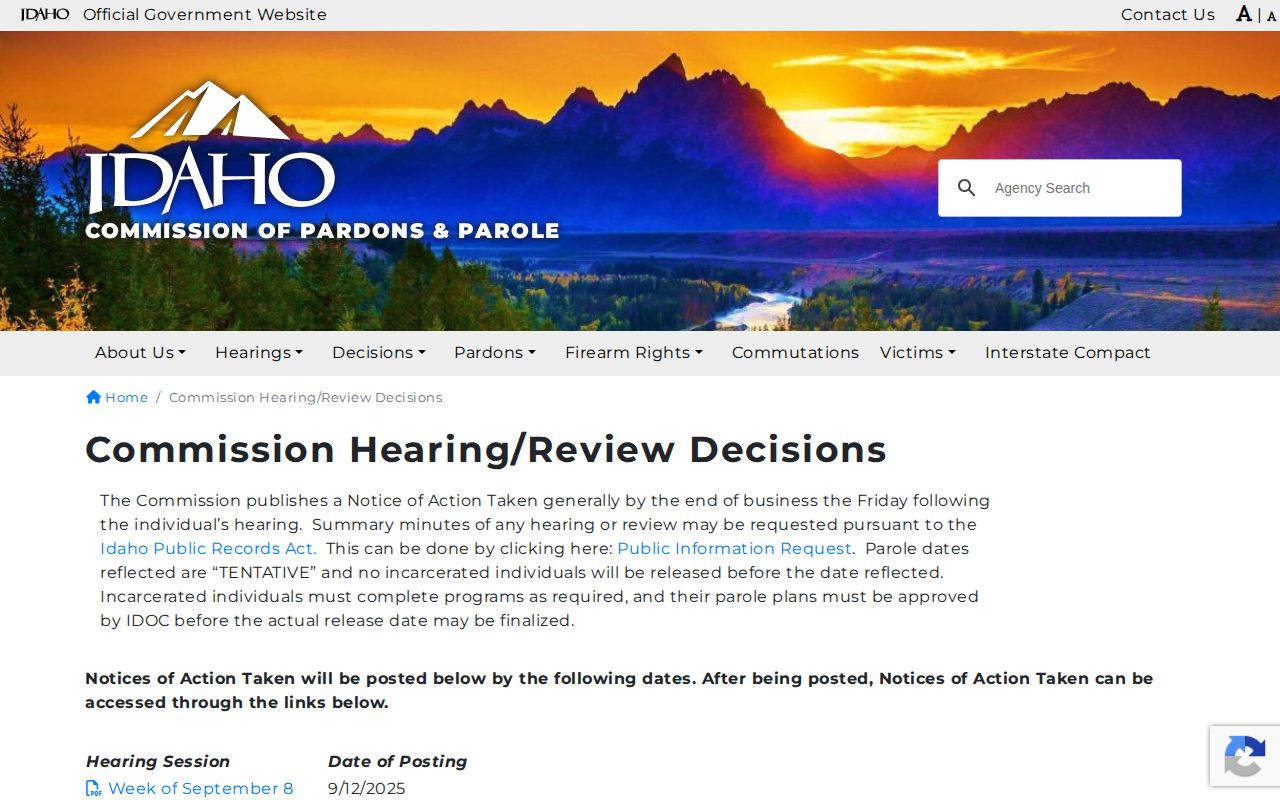
The captured notice source helps separate conditional authorization from an actual Franklin County parole release.
Franklin Supervision Record Requests
When public fields do not reconcile, request the existing IDOC status or sentence record and the Franklin court order. Give the IDOC number and case number. A district office can confirm the public supervision route, while protected schedules and case-management details remain unavailable.
Franklin Probation Court Records
Probation remains under court jurisdiction even though IDOC supervises it. Read the Franklin judgment, later violation filings, warrants, and discharge entry with the Resident/Client detail. A court order can place someone on probation after a host-jail release without any state-prison parole event. That distinction prevents a county departure from being mislabeled as parole.
Use the live detail’s officer contact when available. The general Preston satellite is a fallback, not proof of one person’s assignment. Public verification should stay limited to status, district, and the channel that confirms it.