
Understanding Franklin County Releases
Franklin County does not operate the kind of public, county-branded jail roster that makes a release easy to trace in one place. The Franklin County Sheriff’s Office points to Caribou County detention information. The county court page also lists Bannock County Detention Center and Cache County Jail. Thus, the arrest record, physical custody record, and court record may sit with different offices.
“Released” must always name the setting. Leaving Caribou, Bannock, or Cache custody may mean bond, a court order, time served, another county’s warrant, transport back to Franklin County, commitment to IDOC, or a federal transfer. A person released from prison to parole is outside the prison but remains under supervision. A discharged IDOC client has satisfied the displayed sentence. None of those terms means the same thing as a dismissed charge.
Key distinction: a missing name proves only that the person is not visible on that roster at that moment. Confirm the release type and destination with the physical custodian.
Franklin County Release Types
The code attached to a jail exit explains what happened next. It should be read beside the court order and any receiving-agency record. These common terms are not findings of guilt or innocence.
| Release entry | What it usually means | Next check |
|---|---|---|
| Bond or own recognizance | The court authorized pretrial release, with or without money bond. | Franklin iCourt for conditions and later case events. |
| Time served or sentence complete | The custodian processed a sentence-based exit. | Judgment and jail release timestamp. |
| Transfer or hold | Custody passed to another jail or agency. | Destination field, receiving jail, IDOC, BOP, or ICE. |
| Probation or parole | The person is in the community under rules. | IDOC Resident/Client Search and District 6. |
| Discharged | The displayed IDOC sentence is satisfied. | IDOC detail and the Franklin court case. |
“Released to supervision” is a placement, not the end of all legal duties. “Transfer” is not community release. A court dismissal may end a charge but does not supply the precise time the jail opened the door. Keeping the labels intact prevents a broad claim from replacing what the agency actually recorded.
Franklin County Release Record Fields
A complete release record links a person, a booking, and an exit event. Franklin’s unusual hosting arrangement can split those details. The Sheriff may hold arrest and transport records, the host jail records admission and departure, and the District Court holds the legal order behind bond, probation, dismissal, judgment, or commitment.
| Field | What it shows |
|---|---|
| Name, alias, age, identifier | Helps match the event to the right person; use at least two identifiers. |
| Booking number and date | Connects the release to a specific custody episode. |
| Arresting agency and facility | Separates Franklin’s case role from the jail that held the person. |
| Charge, case, and bond | Points to the controlling Franklin court file. |
| Release date and time | Shows when that custodian recorded departure. |
| Release type or destination | Distinguishes community exit from transfer or another hold. |
Not every field is public. Juvenile information, sealed cases, exempt law-enforcement material, and protected personal details have stricter limits. A public record can also contain redactions. When dates conflict, retain each agency’s label and timestamp instead of silently choosing one.
Franklin Court Routes Custody Checks
The Franklin County District and Magistrate Court page does more than provide court contacts. It links detention information for Bannock, Cache, and Caribou, and it offers a written records-request form. That makes the page a practical map when the Sheriff site does not show a Franklin roster.
The court record answers the legal half of the question. Bond information, register entries, judgments, warrants, probation orders, commitments, and dispositions can explain why custody changed. The host jail answers the physical half. Compare both before deciding that a person entered the community.
The official Idaho iCourt Smart Search accepts names in “Last, First” order, an exact case number, or a partial name using at least four letters followed by an asterisk. CAPTCHA and public-access limits can affect a search. A no-result may reflect spelling, sealing, or legacy numbering rather than the absence of a case.
Request Franklin County Release Records
Send narrow requests to the office that created each record. Idaho’s Public Records Act requires a clear request to the custodian. For an Idaho resident, the usual response is within three working days, while a written extension may reach ten working days. Current law provides different periods for certain nonresident requests.
- Ask Franklin Sheriff to identify the physical facility and provide Franklin-created arrest or transport material.
- Ask Caribou, Bannock, or Cache for the booking, release timestamp, release code, and destination for the actual stay.
- Ask the Franklin clerk for the bond order, judgment, commitment, dismissal, or other controlling document.
- Use the IDOC public-record portal only for state commitment, sentence calculation, prison release, or supervision records.
Give the full name, booking or case number if known, date range, and a short list of records. Ask for an existing electronic copy and advance notice before costs exceed a set amount. Do not confuse the Sheriff’s civil-service fee with a public-record copying fee. If part of a record is exempt, request the segregable public remainder and the statutory basis for each redaction.
Idaho Release Record Boundaries
Idaho Code Title 74, Chapter 1 governs public-record access. Section 74-102 addresses inspection, copying, and fees; section 74-103 sets response timing; and section 74-105 covers law-enforcement exemptions. These laws support access to existing public records, but they do not require an office to create a new release analysis.
Idaho does not offer a broad adult expungement rule for every arrest or conviction. Section 67-3004 creates a limited shielding petition for listed misdemeanors after detailed conditions are met. Section 67-3014 is a specialized sealed remedy for qualifying trafficking victims. A pardon is separate and should not be described as automatically deleting every booking log, index, photograph, or news item.
Retention and public access are separate issues. A host jail may stop displaying a booking after release while still retaining the underlying record under its schedule. IDOC may retain a discharged person’s name even when conviction details no longer appear on the basic result. The court docket can remain the most durable public trail, subject to sealing rules. A requester should ask the custodian for its existing record and retention policy rather than assuming that a web page is the full archive.
Juvenile custody follows a different system. Franklin County materials do not create a public juvenile roster, release list, or mugshot lookup. An authorized person should use the responsible juvenile agency or court channel. The same restraint applies to sealed, exempt, and protected material. Public-record law does not turn every piece of a custody file into public information.
Find Released Franklin County Inmates
Start with custody, then move outward. This order reduces false matches and keeps a court event from being mistaken for a physical release.
- Check the Franklin Sheriff and court routing pages to identify Caribou, Bannock, Cache, or another custodian.
- Search the host jail’s official current interface. If the name vanished, ask for the release event and destination.
- Search iCourt for the order or case event that explains the change.
- Use IDOC when the person was committed to state custody or placed on felony probation or parole.
- Use Idaho VINE for status changes and alerts, then verify any alert with the reporting agency.
- Use BOP or ICE only when the record supports federal custody or transfer.
Franklin County publishes no verified 24-hour release list or 72-hour archive. Those pages explain the host-jail and records-request fallbacks. For a future state date, use the projected release date guide instead of applying a percentage formula.
Cross-Border Franklin County Custody
Cache County Jail sits in Utah, yet Franklin County’s Idaho court page lists it as detention and visitor information. An Idaho-only jail directory can therefore miss the physical custodian. Search the official Cache County inmate list for the custody episode, then return to Idaho iCourt for the Franklin prosecution.
Crossing the state line does not move the criminal case to Utah. It separates the jail record from the case record. If Cache reports transfer rather than community release, follow the named receiving agency. Never merge a Utah Franklin County result or another same-named county into this Idaho search.
IDOC Search for Franklin Releases
The IDOC Resident/Client Search covers state prisoners, people in county contract beds under IDOC jurisdiction, and clients on probation or parole. Search by a last name of at least two characters, with an optional first name, or by the first three digits of an IDOC number.
Open the official IDOC search form before comparing its fields.
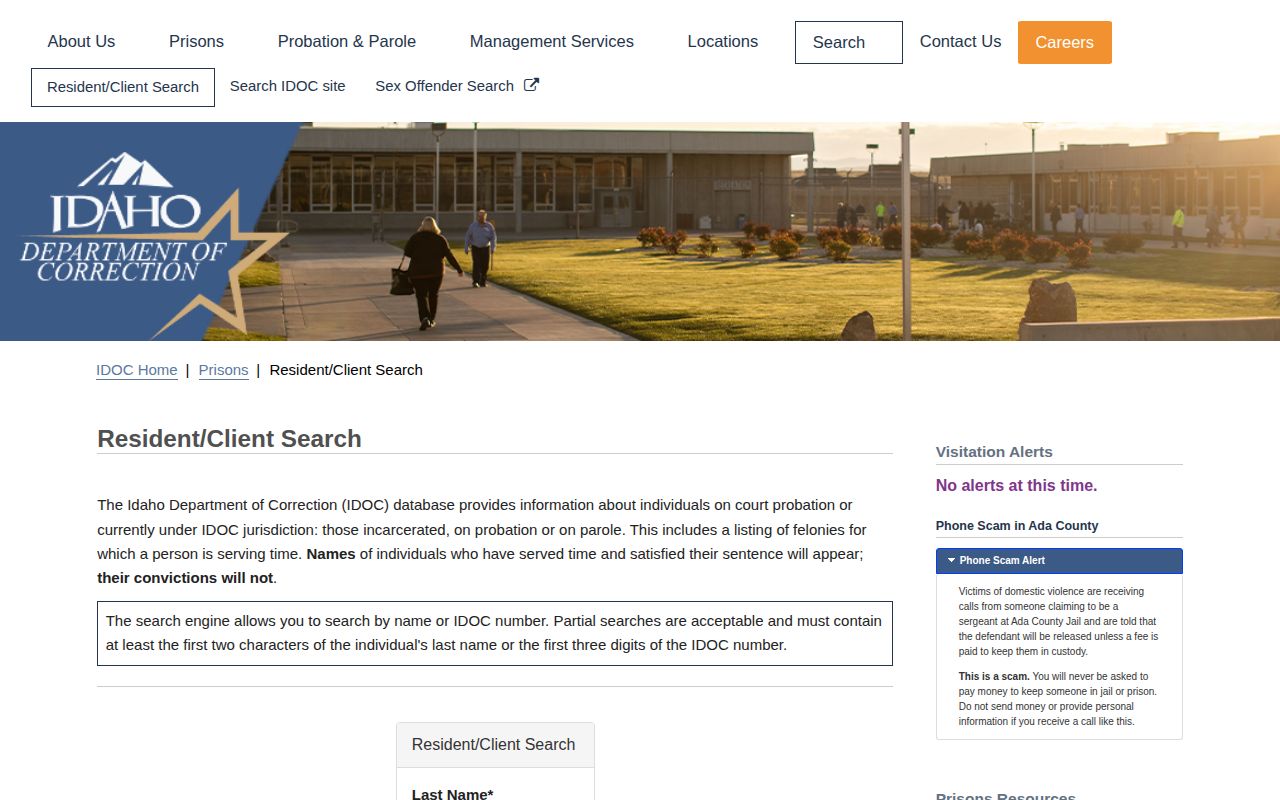
The screen routes a name or IDOC-number query into records whose detail pages can show status, location, sentencing county, case number, sentence status, Released to Supervision, Sentence Satisfaction Date, Parole Eligibility Date, and Next Parole Hearing Date.
Preserve IDOC’s wording. “In custody” identifies state jurisdiction and placement. “In community” points to probation or parole, which the detail page distinguishes. “Active Bench Warrant” proves neither custody nor freedom. “Discharged [date]” means the displayed sentence was satisfied. Daily updates can lag a fast transfer or release.
No Franklin Recent Release Feed
No official Franklin County 24-hour list, 72-hour list, mobile inmate app, or booking-photo feed was located. The Sheriff’s Facebook link is a news channel, not a custody database. AlertSense is for emergency and community alerts, not inmate release notices. Idaho VINE is the proper statewide status-notification service.
The lack of a county feed makes roster disappearance unusually unclear. A person may move among contract custodians or cross the Idaho-Utah line. Use the host’s release record, Franklin iCourt, and the next custodian’s locator as a chain. If no live interface retains the event, request the existing booking and release record.
Verify Franklin Post-Release Supervision
Franklin County belongs to IDOC Probation and Parole District 6. The Preston satellite is a supervision office, not a jail. Probation is court-ordered community supervision. Parole is conditional release authorized by the Idaho Commission of Pardons and Parole after a prison term. IDOC supervises both, but the Commission does not decide probation cases.
Open the person’s IDOC detail first. Compare sentencing county, case number, status, sentence status, Released to Supervision, and district. Then use the Franklin parole and probation guide for the District 6 route and the difference between a Commission decision and an actual release.
Franklin Release Alerts and Transfers
Idaho VINE receives participating jail and IDOC status data. Register on the correct in-custody record for offered phone, text, or email events. A release alert is a lead. Record its wording, time, agency, and identifier, then confirm release type and destination with that agency and check the court or IDOC record.
For a federal commitment, the BOP Inmate Locator can retain records since 1982 and may show a past release date, “RELEASED,” or “Not in BOP Custody.” It does not cover an ordinary Franklin charge. “IN TRANSIT” remains custody. If a local jail reports an immigration transfer, use the ICE locator; no ICE result is not proof of community release.
A federal pretrial hold can also be misleading. The U.S. Marshals Service may place a person in a contract bed, but it does not provide a public prisoner locator. Follow the physical host jail and federal court record until a later BOP commitment appears. An ICE detainer has a similar split: the local jail can record departure to another agency while the person remains in government custody. Preserve the local destination field even when the federal locator has not updated.
Federal locator fields require their own reading. A past BOP release date with no facility supports that BOP custody ended, but another case or supervised release may continue. An ICE search generally uses an A-number with country of birth or exact biographical data. Processing delay, spelling, transfer, removal, protected status, or short-term custody can all produce no result. The last confirmed agency remains the best starting point.
Compare Franklin Release Sources
| Source | Best use | Limit |
|---|---|---|
| Host-jail roster | Current physical custody | A vanished name does not explain destination. |
| Host release record | Exit time, code, destination | May require a records request. |
| Franklin iCourt | Bond, order, judgment, disposition | Not a live physical locator. |
| IDOC search | State custody, supervision, discharge | Does not cover ordinary county-only release. |
| VINE | Status-change notice | Alert must be confirmed. |
| BOP or ICE | Supported federal path | Separate from county and IDOC systems. |
Match at least two identifiers, such as booking or IDOC number, case number, birth year, age, or facility. Keep the event date beside the source. When records disagree, report the conflict and ask each custodian to explain its own field.
Franklin County Release Facilities
The facility map follows the record, not merely the county border. Each page explains who the system covers and how to confirm where a person went.
- Franklin County Sheriff’s Office, the local arresting and records agency.
- Caribou County Jail / Detention Center, the detention link on the Sheriff page.
- Bannock County Detention Center, an outside holding route listed by the court.
- Cache County Jail, the cross-border Utah custody route.
- Idaho Department of Correction institutions and contract locations.
- IDOC District 6, Preston satellite, for community supervision.
- Idaho juvenile corrections, a separate confidential system.
- Federal Bureau of Prisons, for federal commitments.
- ICE Enforcement and Removal Operations, when a documented transfer points there.